Considered options, individually assessed
Nipple inversion correction can be performed as a standalone procedure, or — in selected patients — at the same time as breast augmentation. The technique used depends on the degree of inversion, the underlying duct anatomy, and what is appropriate for your individual situation.
Inversion may occur on one side or on both. Dr Nara takes time at consultation to assess which is the case for you, to discuss the various techniques available, and to walk through the realistic range of outcomes — including the conversations around sensation, breastfeeding, and the possibility of recurrence.
Where surgery is appropriate, Dr Nara discusses the nature, the risks and the possibility of revision at consultation, then performs the procedure in an accredited and licensed facility, with a written cooling-off period and structured aftercare, in line with Medical Board of Australia guidelines.
If you are looking for a documented record of outcomes, see the before & after section below.
You are not alone thinking about this
An epidemiological study revealed that under 9% of the population have inverted nipples. It is a very common issue — and many patients are conscious about it without knowing who to see or consult.
For some it is bilateral; for some it is one-sided. For some it has been present from puberty; for others it has developed over time. The clinical conversation is the same in every case: what does your anatomy actually show, what is realistic to address, and what technique is appropriate for the goal you have come in with.
A consult — even one undertaken only to understand the matter better — is enough to empower your decision-making, whether you go on to have surgery or not.
Inversion correction during breast augmentation — what the research showed
Dr Nara, together with Dr Hodgkinson, published research analysing whether nipple inversion correction can be safely performed at the same time as breast augmentation. The question matters because little had been written on it in the surgical literature dating back to the 19th century.
- 19 patients in the analysis
- 34 breasts in total (some unilateral, some bilateral)
- 15 patients with bilateral nipple inversion correction
- 04 patients with one-sided correction
The study found that revision rates for the combined procedure — simultaneous nipple inversion correction with breast augmentation — were comparable to isolated nipple inversion correction, when specific techniques were used. Not all techniques have been demonstrated or analysed to work safely in conjunction with augmentation, which is why technique selection is part of the consultation conversation.
A detailed analysis of the demographics of each patient was carried out and presented in the study. The paper is now referenced internationally in cosmetic surgical literature.
Nara, Kishen; Hodgkinson, Darryl J. "Correcting Nipple Inversion Simultaneously with Implant Augmentation of the Breast, Using the 'Pirelli' Technique".
Dr Nara walks through the intricacies of nipple inversion correction with breast augmentation at consultation, including the nature of the procedure, the risks, and the possibility of revision. If you are weighing up the timing, our guide on when to operate on inverted nipples talks through the considerations before you book a consult.
-
01 Can inverted nipples be corrected without surgery?
Some non-surgical devices and suction methods are marketed for inverted nipples, and they may have a temporary effect for milder cases, but they do not reliably provide a lasting correction, particularly where the inversion is caused by tight bands of tissue tethering the nipple. Surgical correction releases those bands and is the option that addresses the cause directly. Whether surgery is appropriate for you depends on the degree of inversion, which is assessed at consultation with Dr Nara. -
02 What are the grades of nipple inversion?
Nipple inversion is commonly described in three grades. Grade 1 is a nipple that can be drawn out fairly easily and tends to stay out for a time; grade 2 is a nipple that can be drawn out but retracts; and grade 3 is a nipple that is difficult to draw out at all, usually because of firmer tethering beneath. The grade helps guide the surgical approach and the discussion about sensation and, where relevant, breastfeeding. Your individual grade is assessed at consultation. -
03 Is inverted nipple correction covered by Medicare?
Where the procedure is performed for cosmetic reasons it is not covered by Medicare or private health insurance, and Dr Nara performs it as a cosmetic doctor. Any quote from RevAesthetic is for the procedure itself. Any medical concern about the nipple is best raised with your GP, who can advise you separately. -
04 Is nipple inversion common?
Yes — far more common than many patients realise. Many patients are conscious about it but unsure who to talk to about it. It is a normal anatomical variation, not something to be embarrassed about. -
05 Can the procedure be done with a breast augmentation at the same time?
Yes — but not with every technique. Dr Nara, together with Dr Hodgkinson, has published research analysing this. The published study found that revision rates of simultaneous nipple inversion correction with breast augmentation were comparable to isolated nipple inversion correction, when specific techniques are used. Whether your individual situation is suitable for a combined approach is worked through at consultation. -
06 What about doing nipple inversion correction on its own?
Yes — nipple inversion correction can be performed as a standalone procedure if you are not also looking at augmentation. The technique used depends on the degree of inversion, the underlying duct anatomy and what you are trying to achieve. -
07 What about breastfeeding?
Some techniques for nipple inversion correction can affect milk ducts and therefore may affect future breastfeeding. If breastfeeding is important to you — now or in the future — raise it at consultation so that the technique can be chosen with that in mind. -
08 What about sensation?
Sensation changes are part of any nipple surgery and may be temporary or permanent. This is part of the consent conversation. -
09 What is the recurrence rate?
Recurrence (the nipple inverting again over time) is one of the considerations specific to nipple inversion correction. The rate depends on the degree of original inversion, the technique used and individual healing. Dr Nara will talk through realistic expectations at consultation. -
10 What are the risks of nipple inversion correction?
All surgery has its inherent risks and complications. There are potential risks of scarring, bleeding, discomfort, infection and contour deformity, as well as the procedure-specific issues of altered sensation, possible effects on breastfeeding, and recurrence. The full list is on our risks of surgery page and is worked through line by line at consultation. -
11 What about scarring?
All cosmetic surgery has some degree of scarring. The scars from nipple inversion correction are generally small and located around the areola. Scars are permanent. They tend to soften and fade over months to years, but the way an individual scar matures is influenced by genetic and personal factors. -
12 How much does the procedure cost?
A formal quote is only provided after your individual consultation, because the technique chosen depends on the degree of inversion and your goals. The personalised quote is provided by Cate, the practice manager, after assessment. Dr Nara is a cosmetic doctor — private health insurance and Medicare rebates do not apply. -
13 What happens at consultation?
There are two appointments before any surgical decision. The first is a face-to-face or Zoom assessment with Dr Nara that takes time — anatomy, the degree of inversion, technique options (including whether augmentation is also being considered), the realistic range of outcomes and the full risks are all discussed, with a chaperone present. The second is a follow-up to revisit anything you have thought about since. A specialist GP referral and a psychological assessment are part of the consultation per Medical Board of Australia guidelines. You are also free to check any practitioner's registration before you book; our guide to checking a doctor's AHPRA registration explains how. -
14 How long is the cooling-off period?
A formal cooling-off period applies between consultation and any procedure, in line with Medical Board of Australia guidelines for cosmetic surgery. The intent is the opposite of pressure — time to read the written consent paperwork, talk to your GP, ask follow-up questions, and decide whether to proceed. The full sequence, including exactly when the seven days start counting, is set out in our guide to consultations and the cooling-off period in Australia.
Our process
From first conversation to follow-up
Every nipple inversion correction patient moves through the same four steps, in the same order. Surgery only happens once steps one and two are done.
- 01
Consultation
A face-to-face or Zoom assessment with Dr Nara, with a chaperone present. We discuss anatomy, medical history, technique options, the realistic range of outcomes, and the full risks. You leave with written information — never a same-day decision.
- 02
Reflection
A formal cooling-off period under Medical Board of Australia guidelines. Time to reread the consent paperwork, talk to your GP, ask follow-up questions, and decide whether to proceed.
- 03
Procedure
Performed by Dr Nara in an accredited and licensed facility. Technique is tailored to the degree of inversion, the underlying duct anatomy and your goals — including whether augmentation is being performed at the same time. You go home with written aftercare and Dr Nara's direct contact.
- 04
Follow-up
Structured reviews through the first weeks and months. Most patients return to non-physical work around one week and to higher-impact activity around six weeks, depending on healing — these are individual ranges, not promises.
Photographic record
Before & after — Dr Nara's patients
A 40-year-old mother of three who decided to have nipple inversion correction surgery after a comprehensive consultation with Dr Nara, considering the different options available. The modified Pirelli technique was used. Results are shown at 10 days following surgery — it is expected that all patients undergo varying degrees of soft-tissue settling through the recovery phase. Photographs are unedited, presented with patient consent, and not retouched.
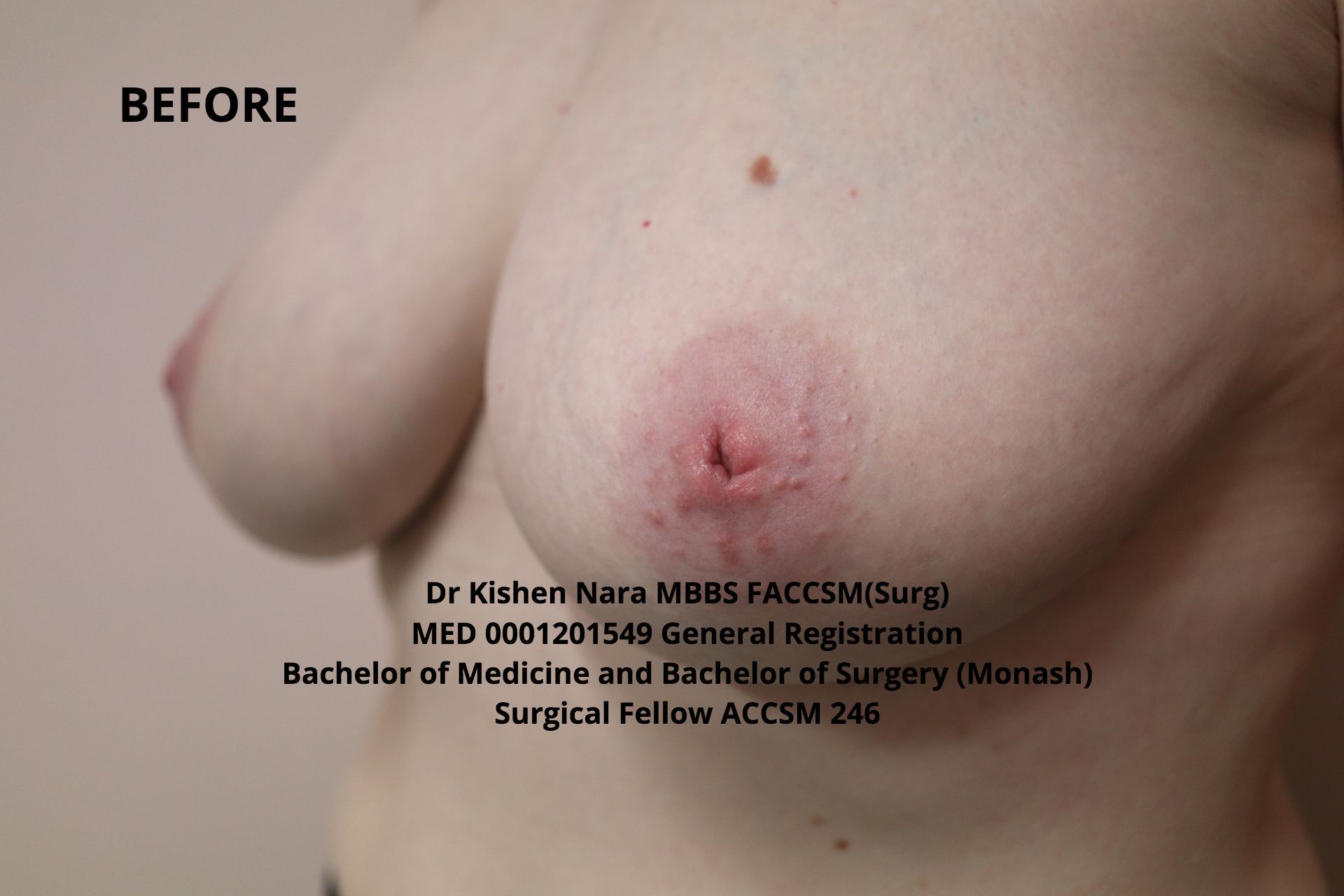
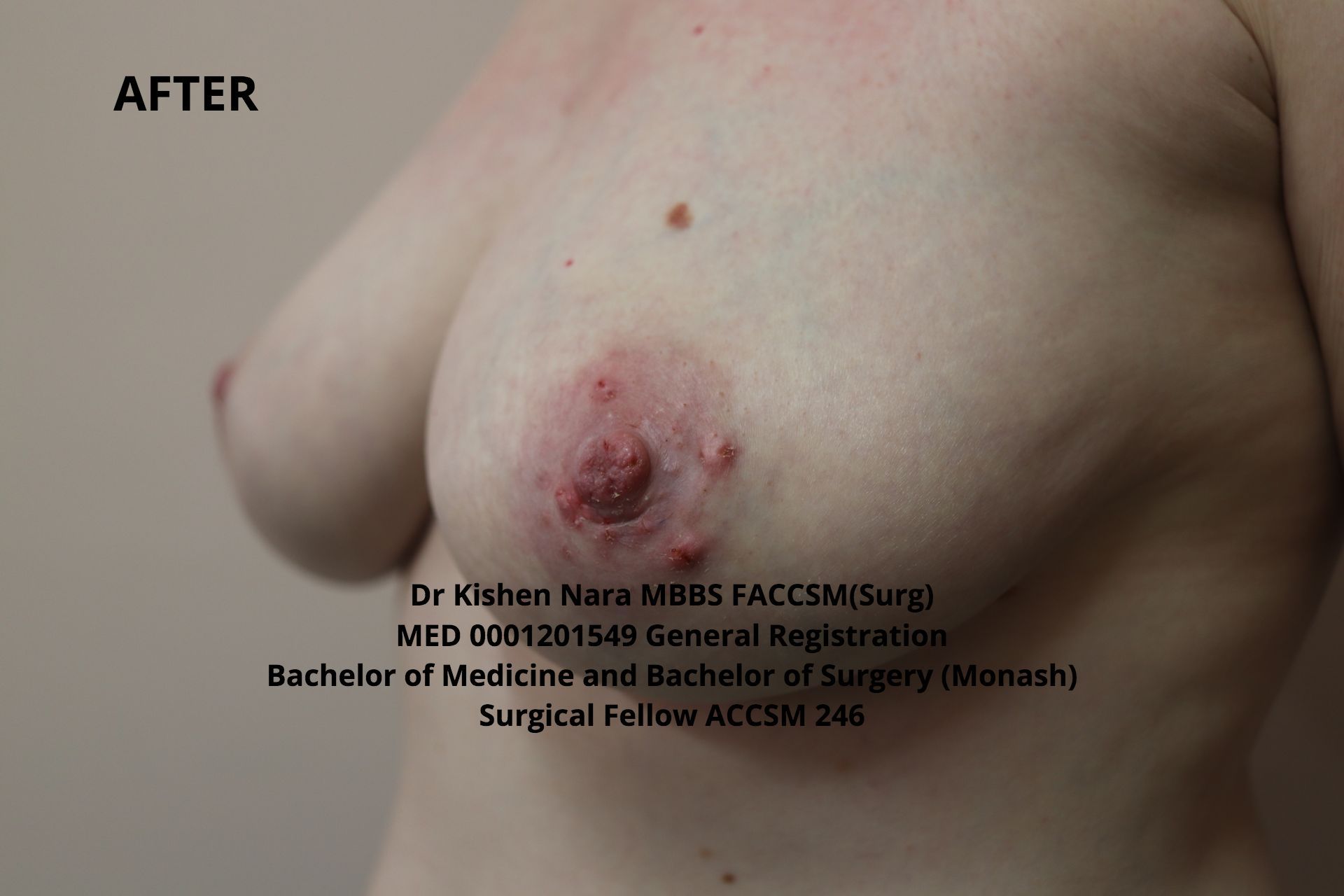
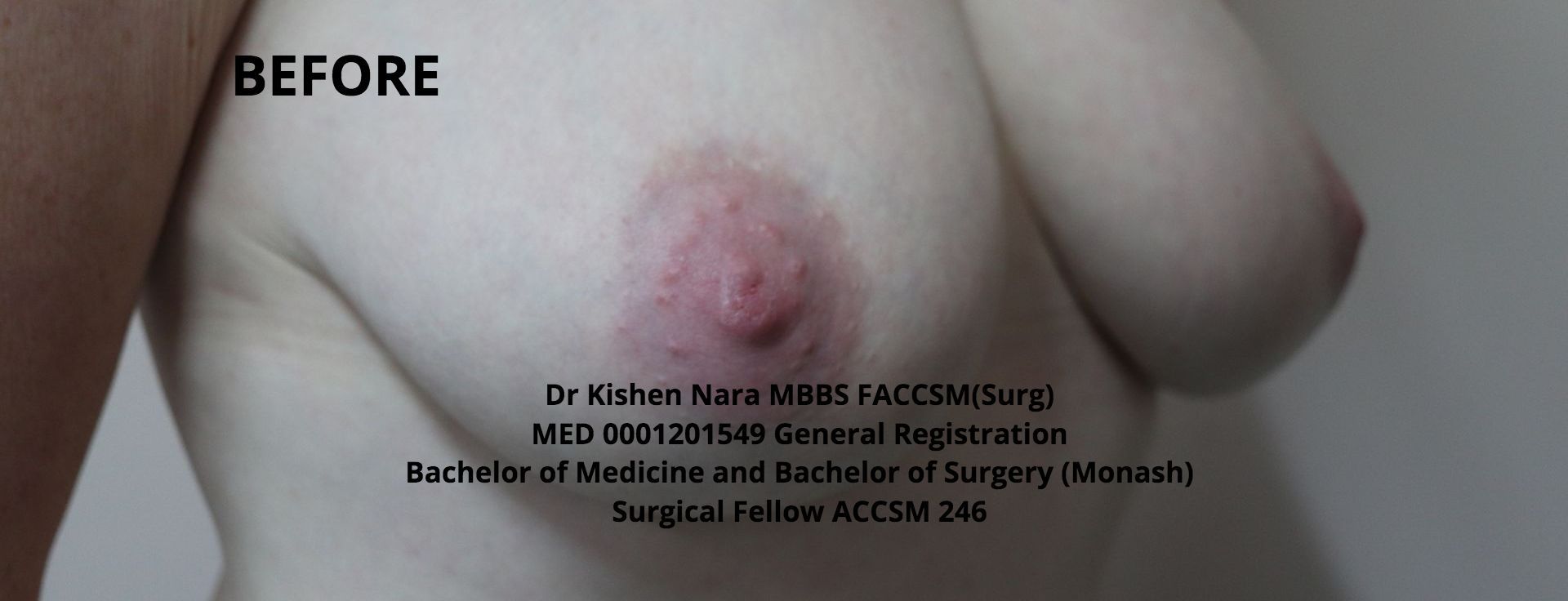
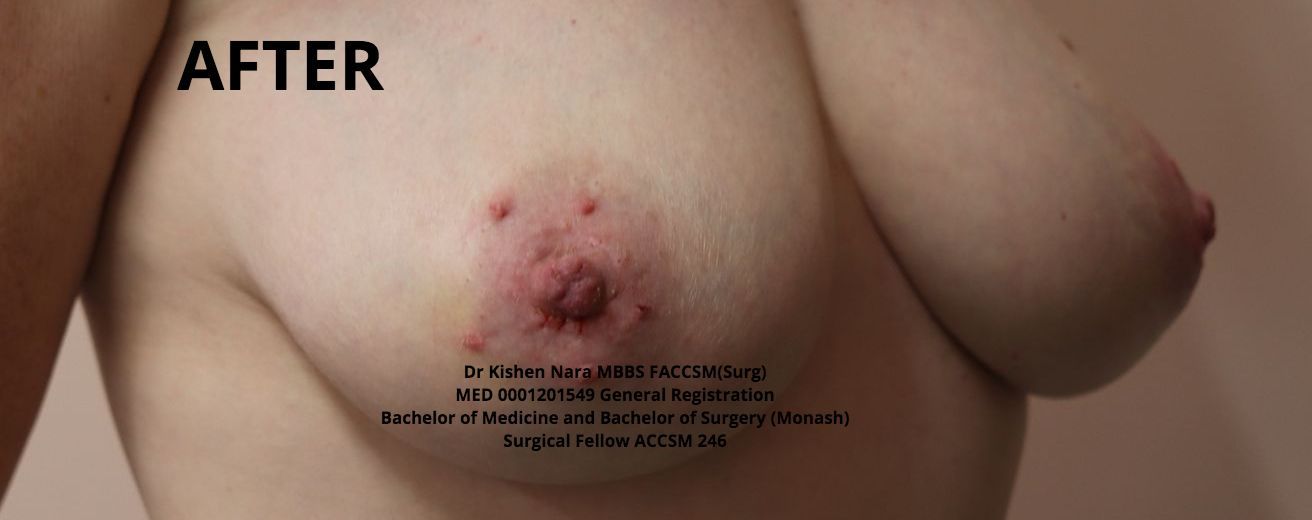
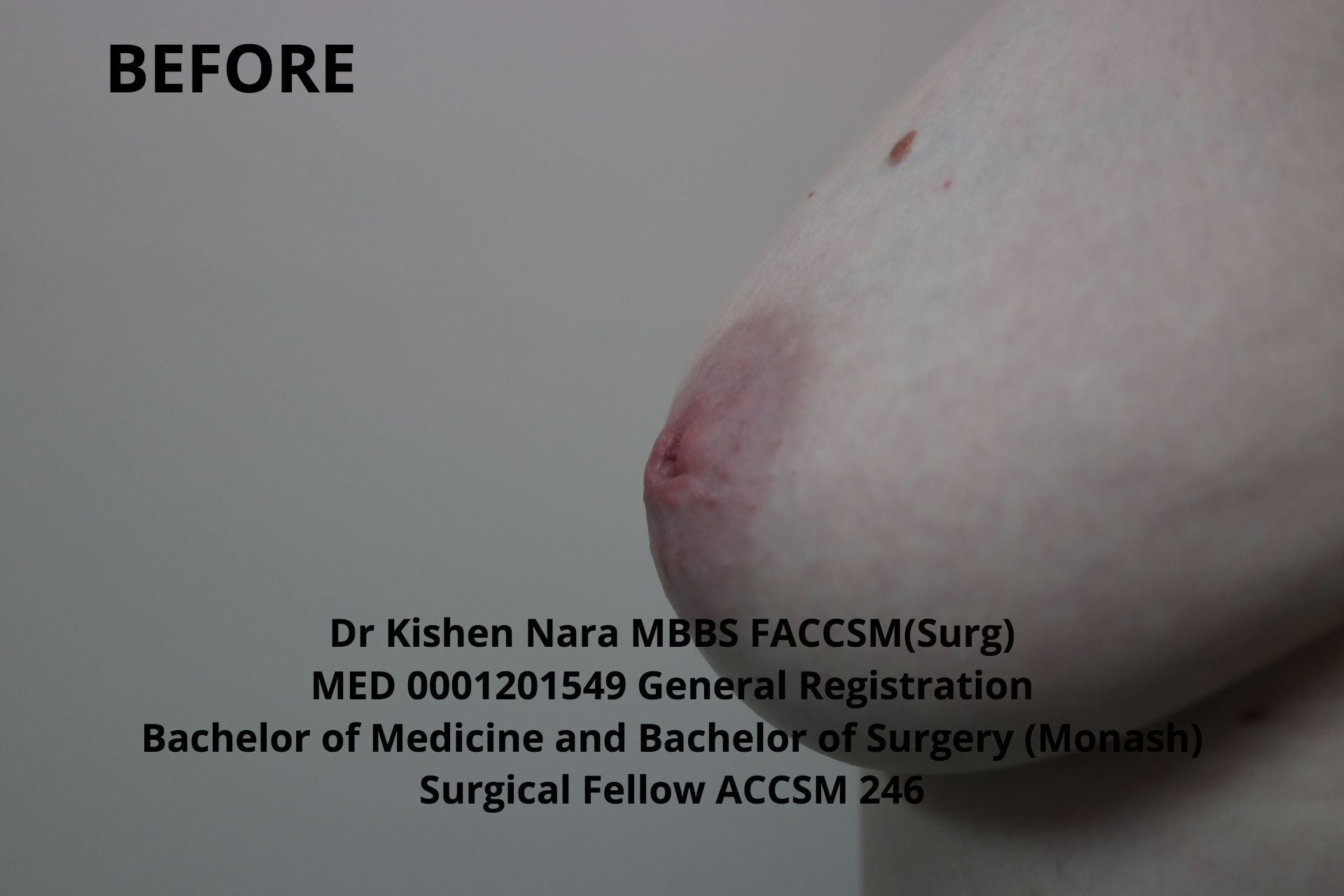
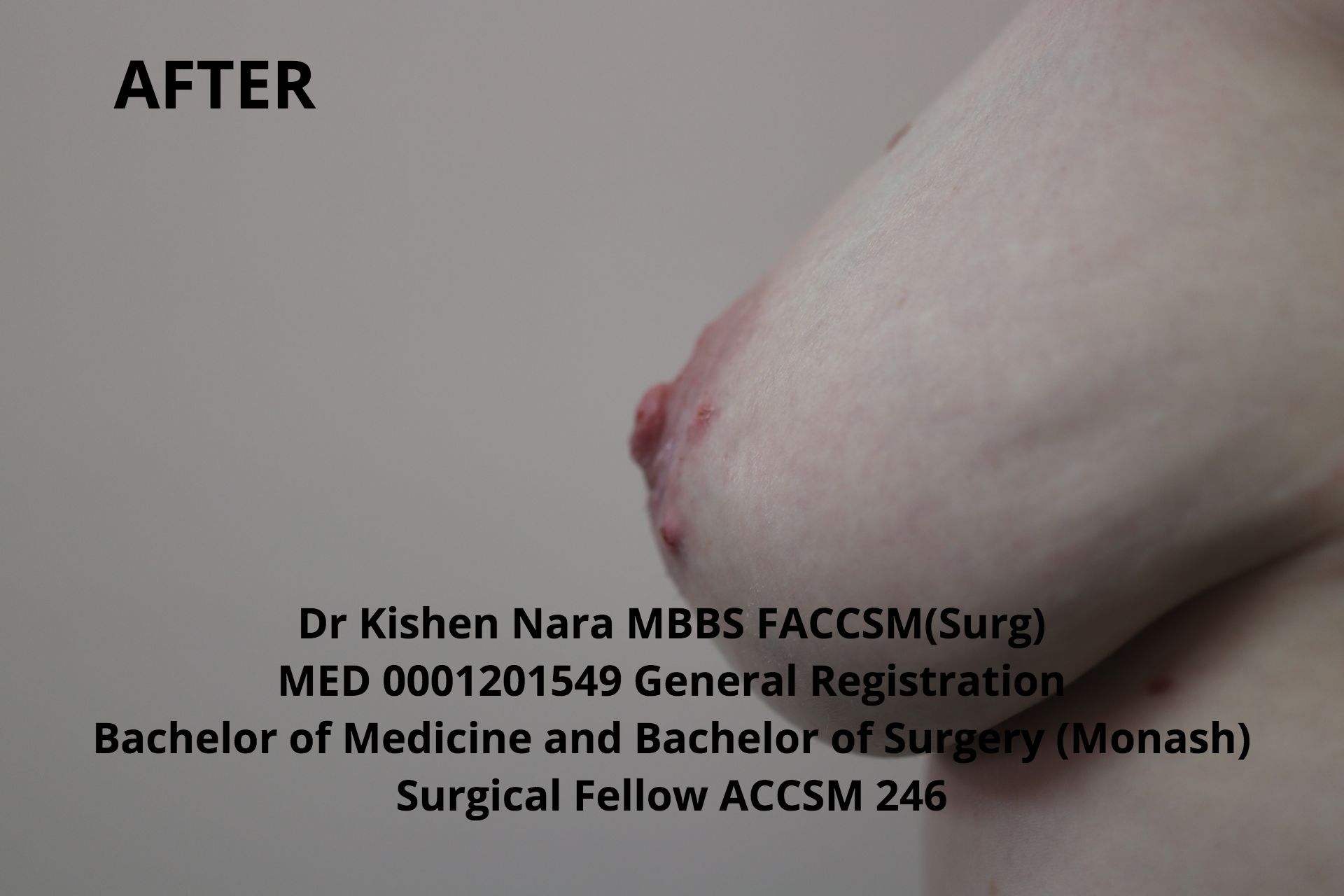
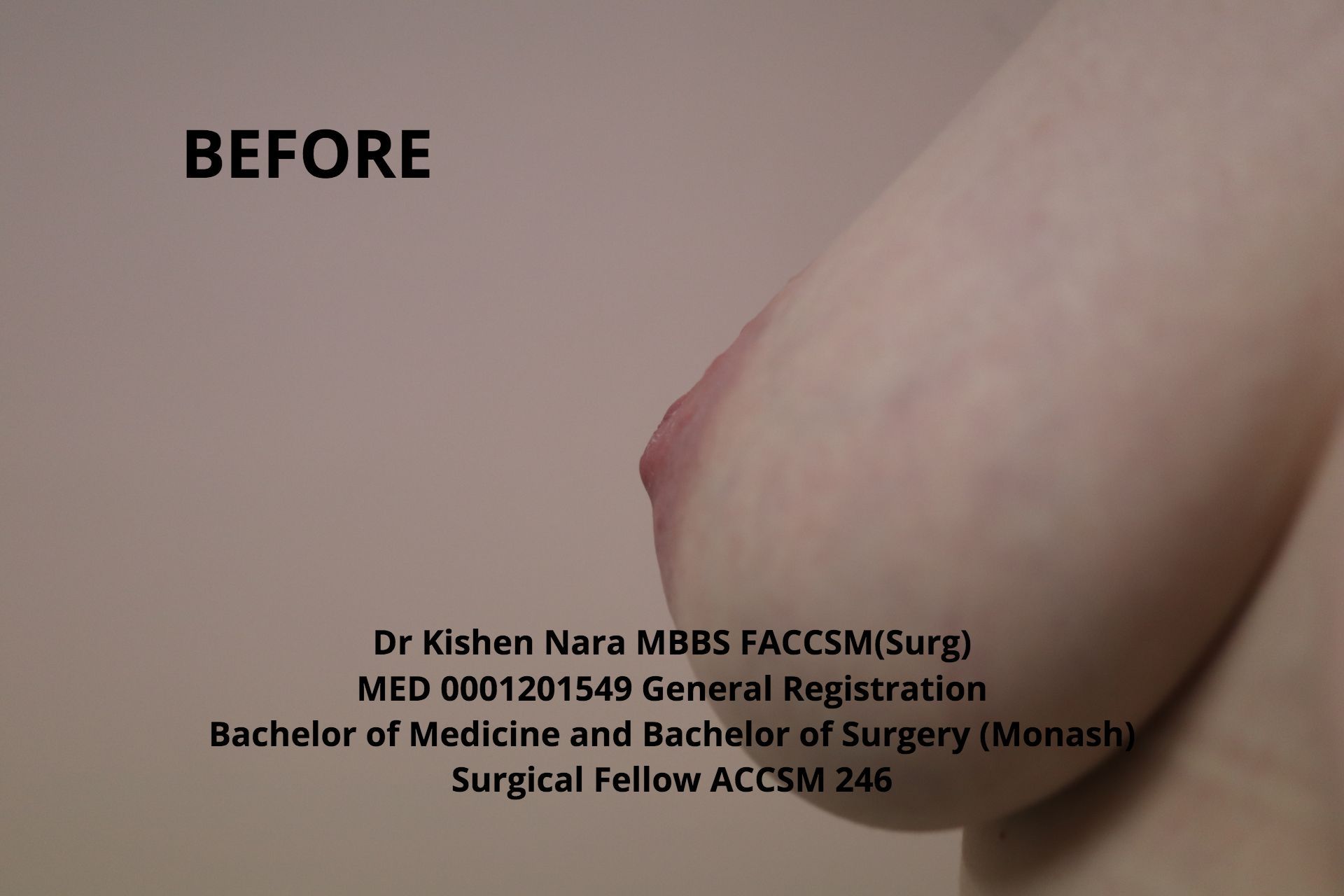
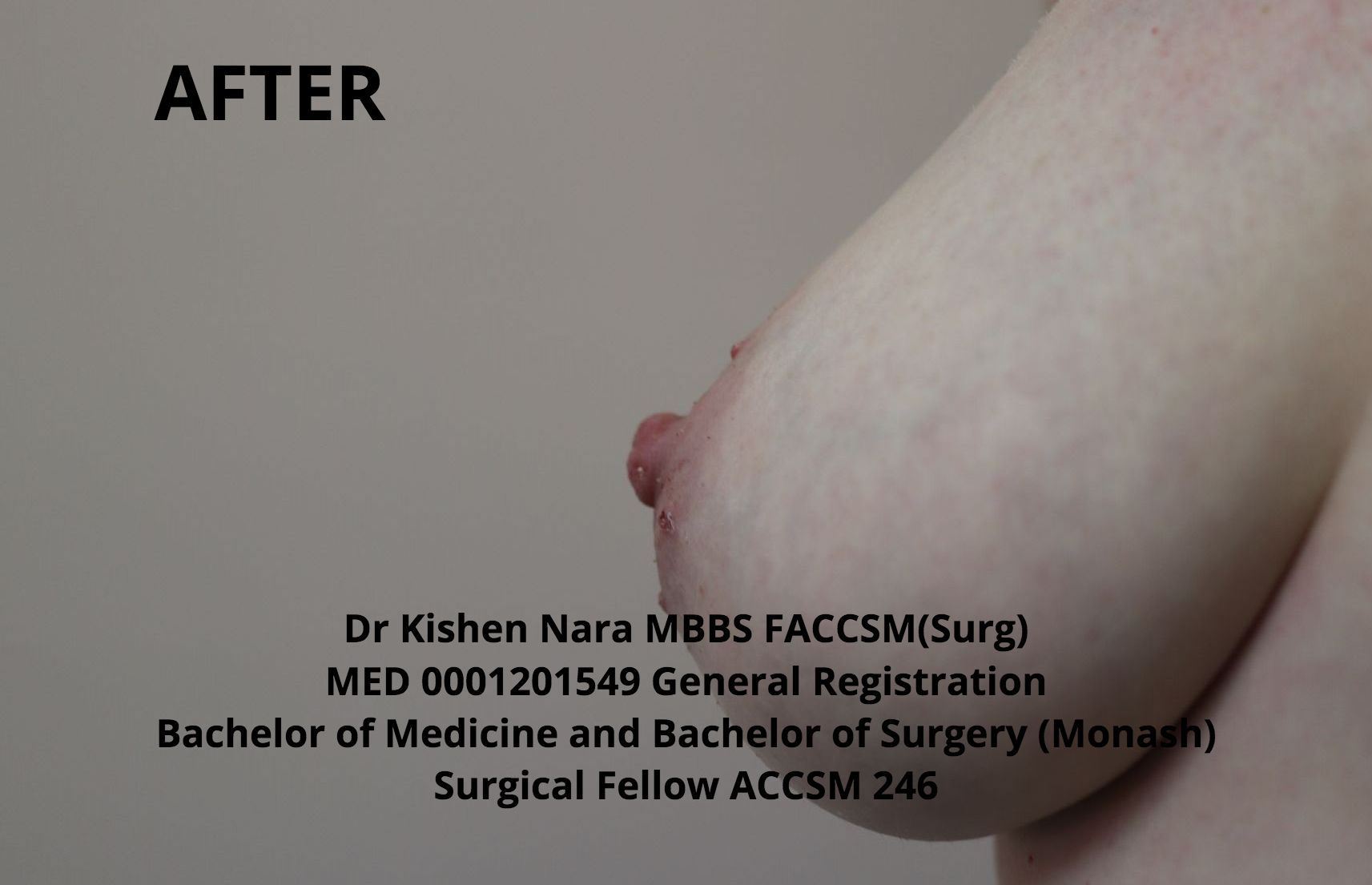
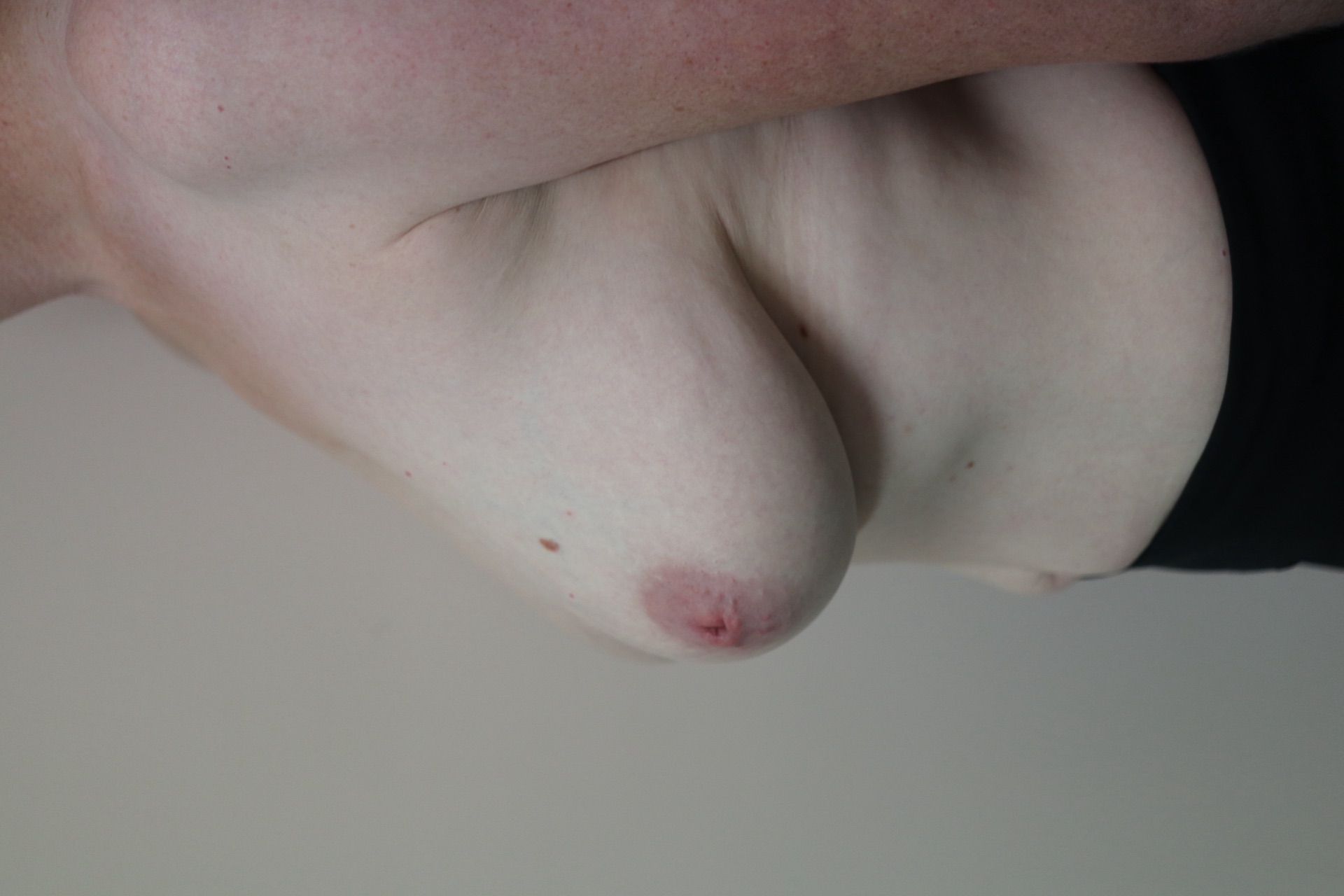
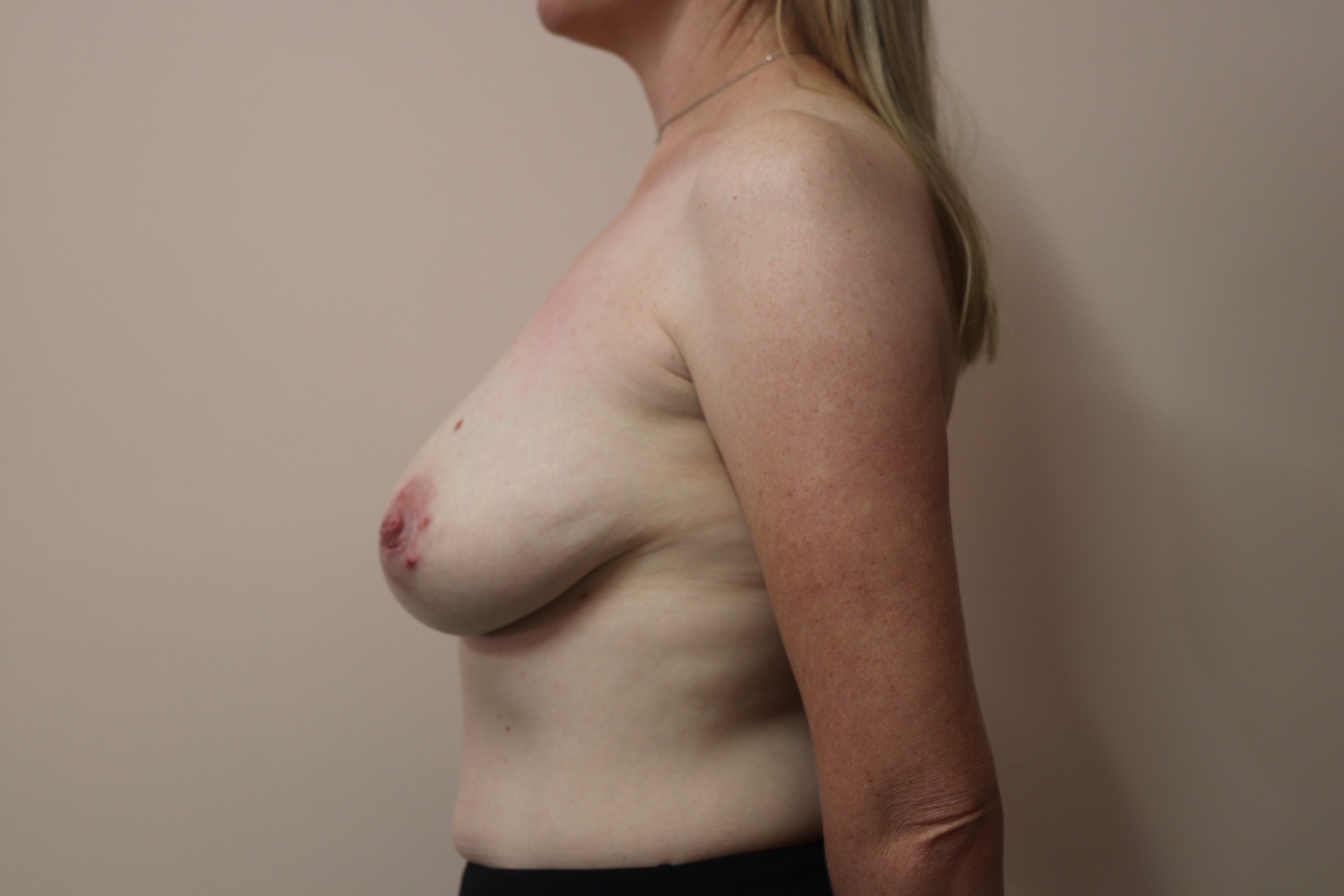
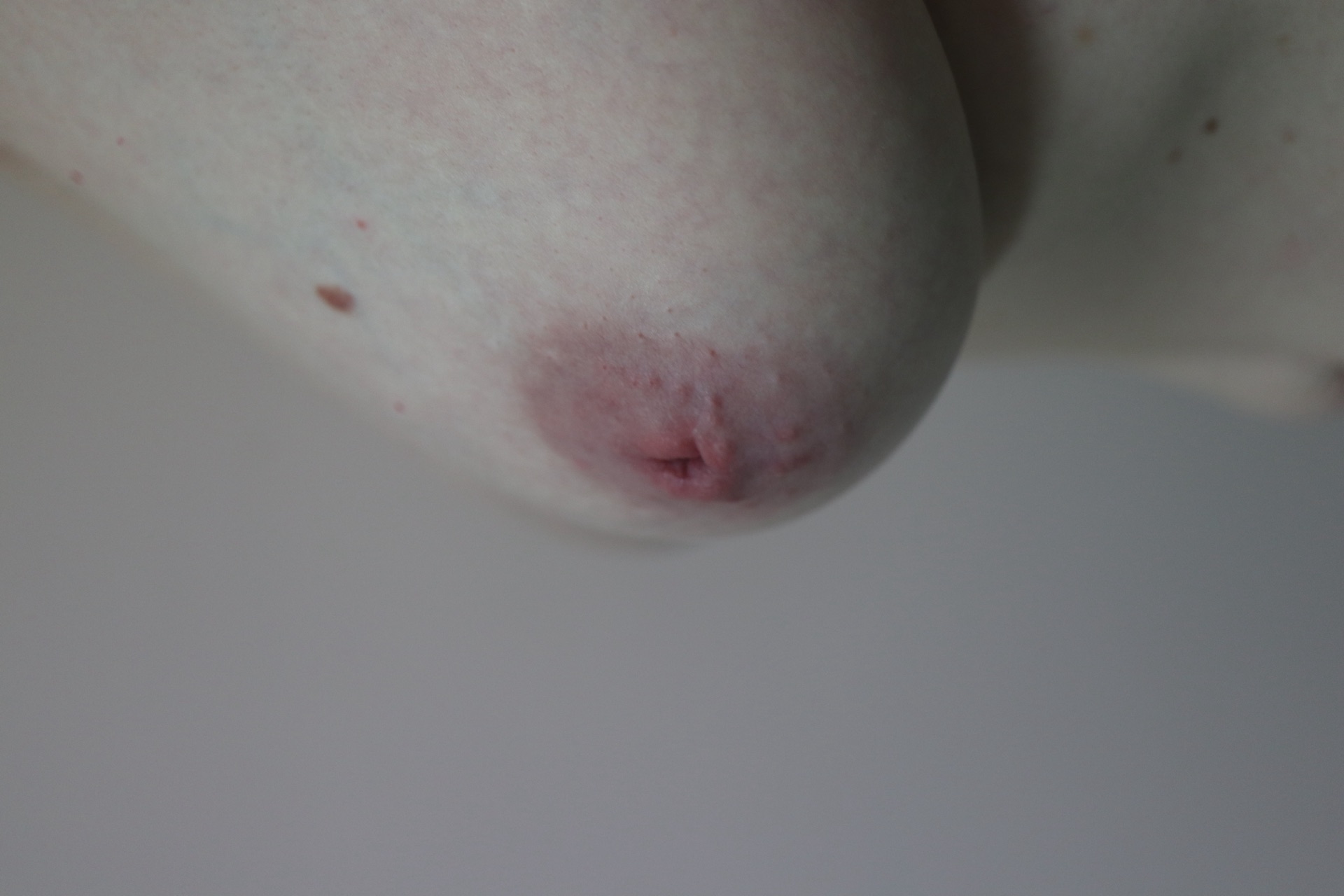
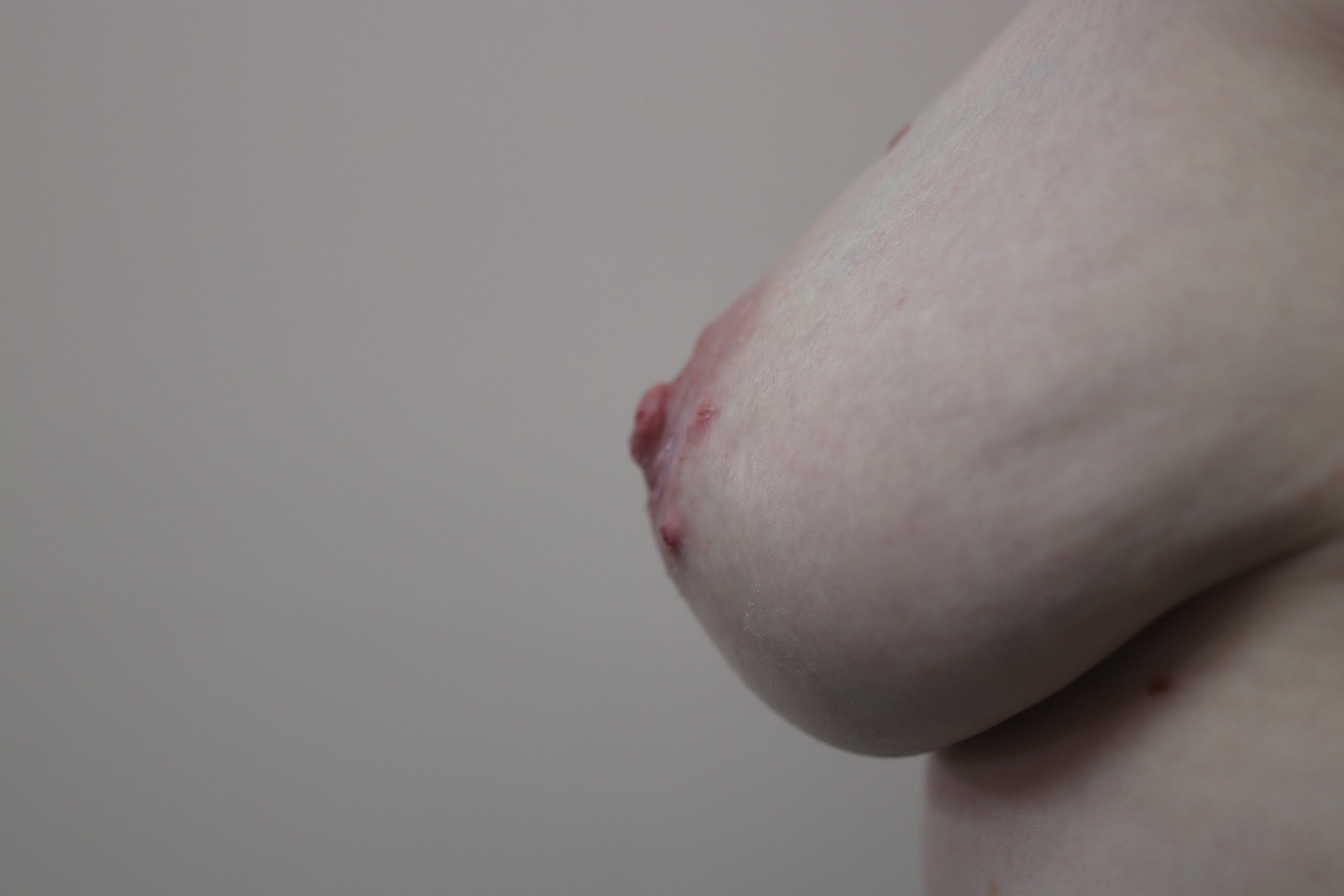
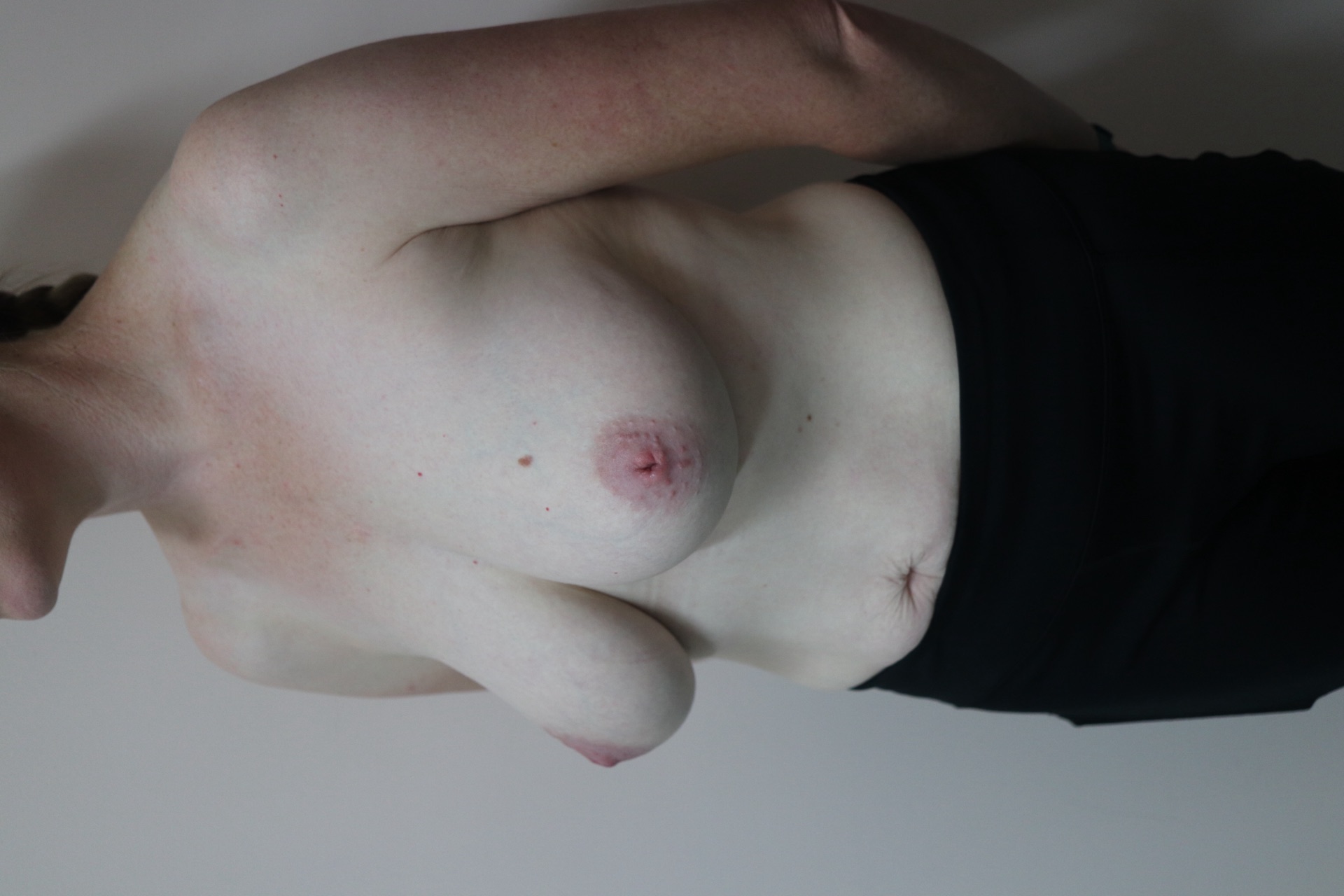
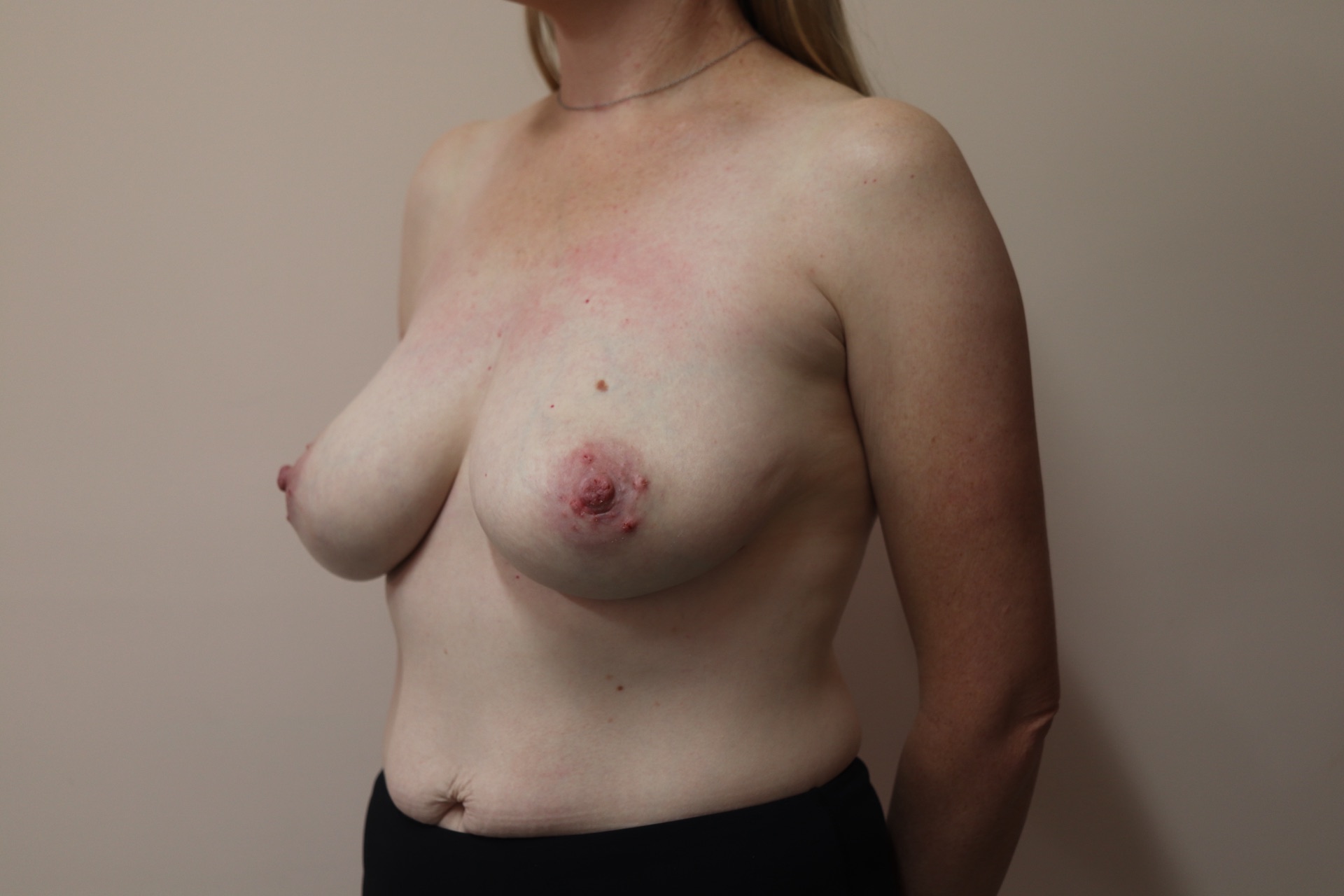
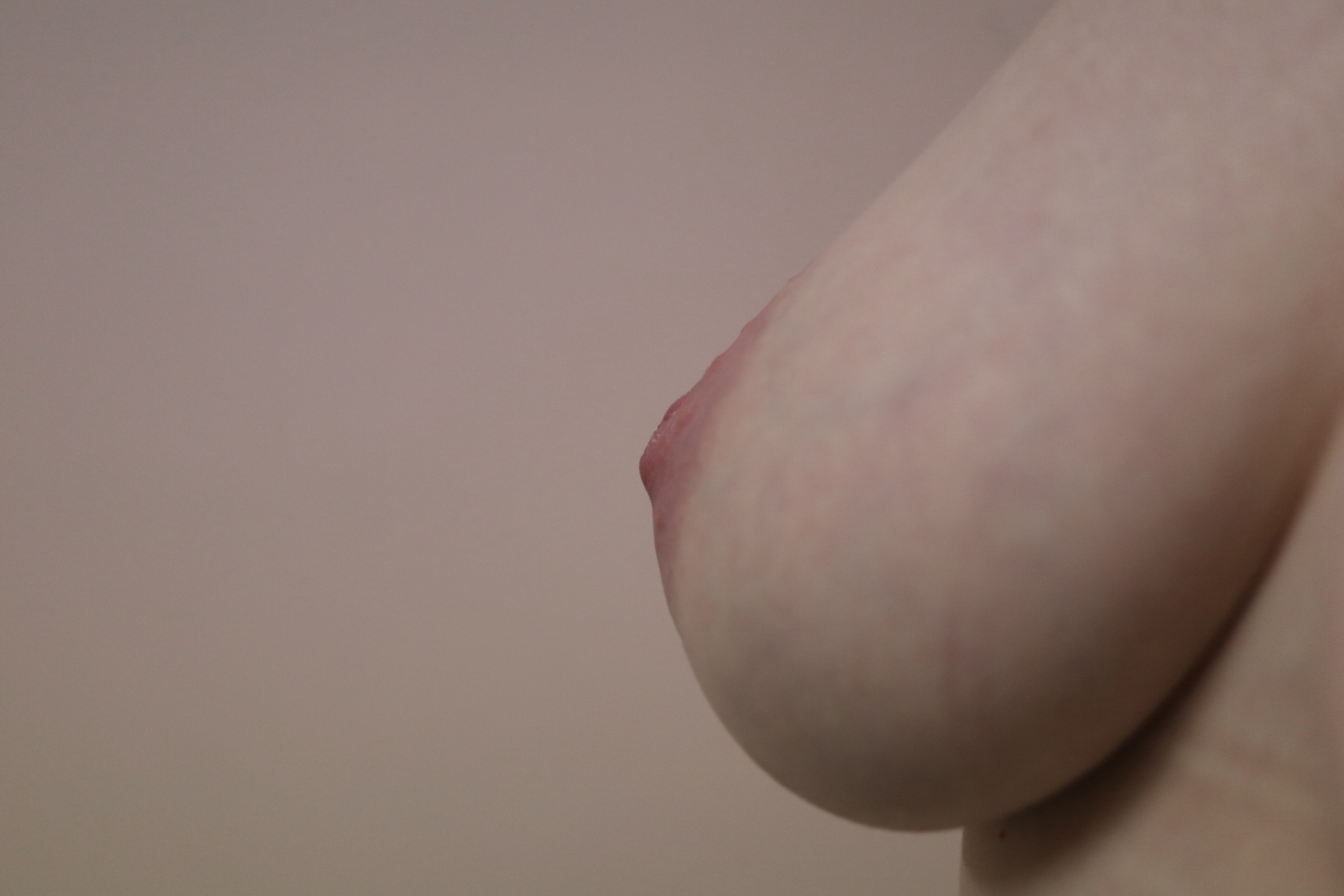
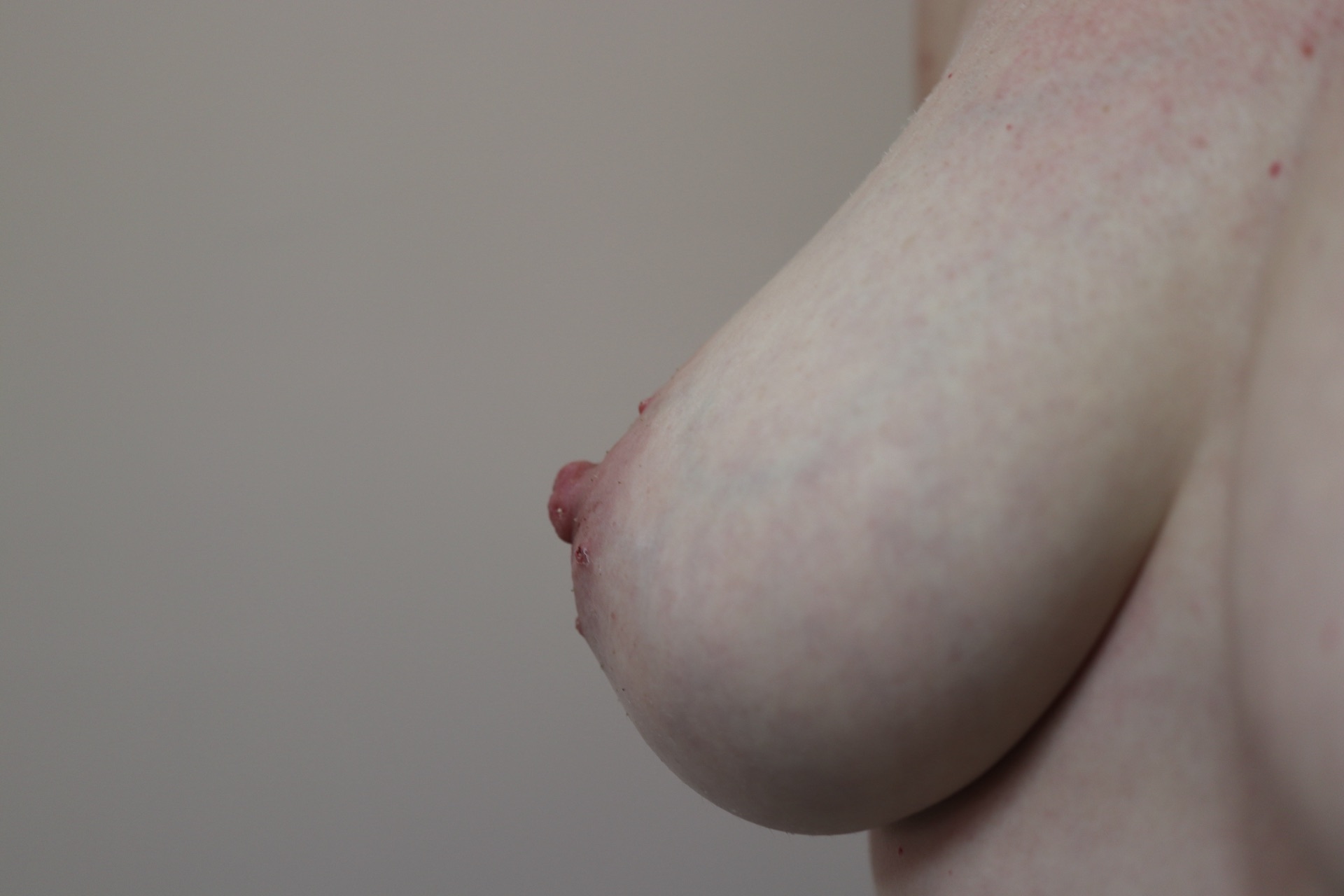
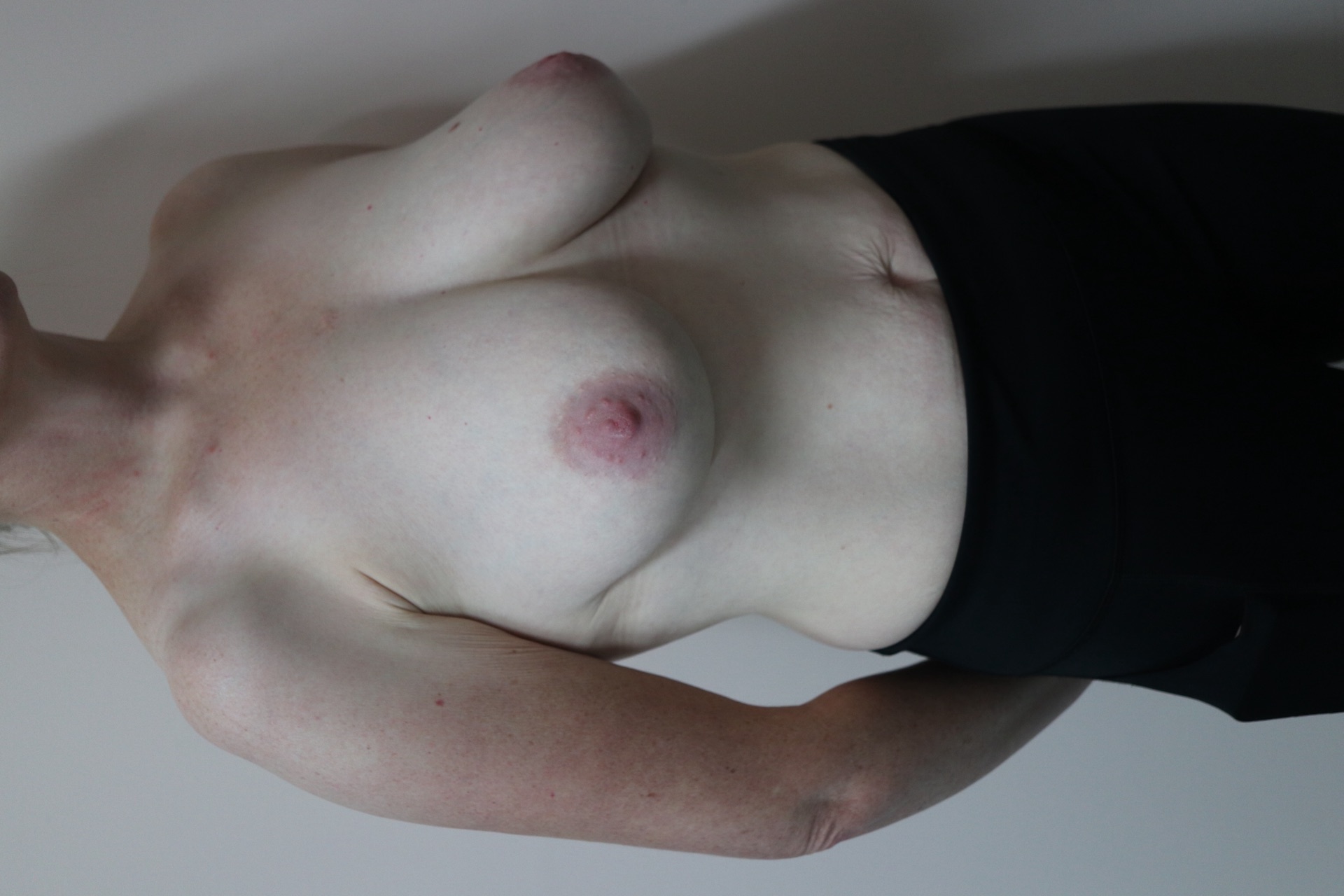
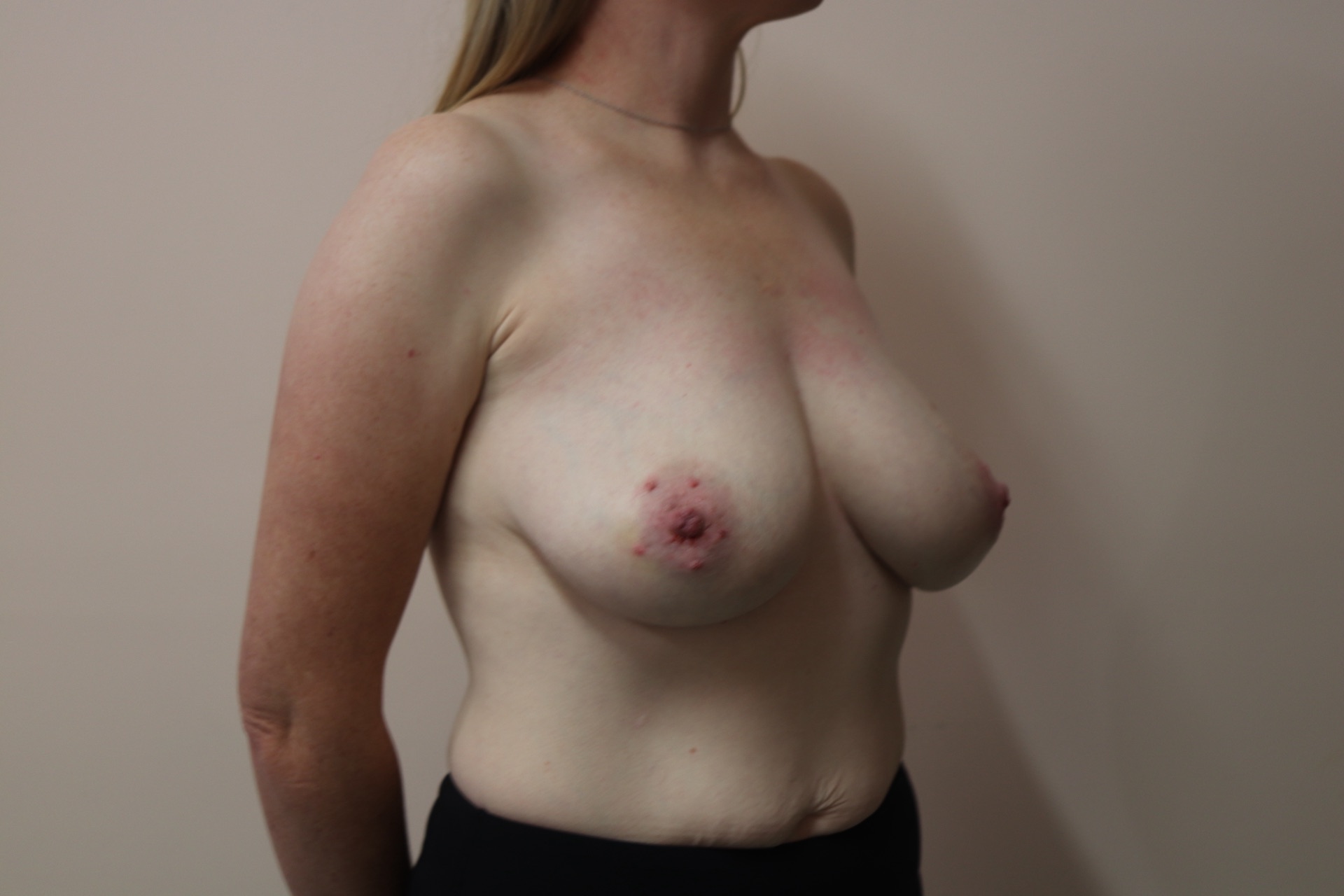
Photographs are part of a clinical record kept under Australian Medical Board guidelines, presented here with patient consent, and are not generalisable to other patients. Recurrence, sensation changes, and scarring are individual — each is discussed at consultation.
Before you book
Come and speak with us about your expectations
We will work with you towards your goals in a trusted, safe and proficient manner. Results vary from patient to patient — each case is unique with its own anatomy, risks and expectations.
All treatments have risks and benefits — to read those in detail, visit our risks of surgery page. It is important to seek a consult with your practitioner in person prior to any treatment, and we encourage you to seek a second opinion before proceeding.
Also offered at the same rooms: ear lobe repair, a separate minor procedure booked and quoted on its own.
Begin a conversation
Reserve your consult
Nipple inversion correction decisions are made in person, after a thorough assessment with a chaperone present. A formal quote is only provided after that consultation.
Submitting this form sends your enquiry to Dr Nara's team. Please don't include sensitive medical details — those are discussed at consultation.